
What an 'AI trading bot' offer claims
An 'AI trading bot' offer claims that a computer program will trade for you and make a profit. From outside, a reader cannot verify that the bot exists, that it trades, that the balance shown is real, or that withdrawals work. A real automated-trading product would disclose the legal entity, the venue where orders are placed, and the custody of money. This page explains the gap.
The claim: a bot trades for you
The offer says a computer program uses artificial intelligence to trade in financial markets. The bot is said to make decisions faster and better than a human. The reader is told to deposit money, and the bot will multiply it. The offer may show a dashboard with a growing balance. The reader is not asked to learn trading. The bot does the work.
The claim is appealing because it removes the reader from the process. No skill is needed. The bot is the expert. But the reader has no way to check that the bot exists. The dashboard could be a simulation. The trades could be fake. The balance could be a number on a screen. The claim is unverifiable from outside.
What cannot be verified from outside: the bot exists
A reader cannot verify that the bot exists. There is no public record of the bot's code or its trading history. The offer may show a name and a logo, but those are easy to invent. The bot could be a person manually entering numbers. It could be nothing at all. The reader has no access to the bot's internals.
A real automated-trading product would disclose the legal entity that operates the bot, the venue where orders are placed, and the custody of money. Those are checkable facts. The bot's existence is not checkable. A reader should ask for those facts. If they are not provided, the bot is a story, not a product.
What cannot be verified: the bot trades
Even if a bot exists, a reader cannot verify that it trades. The offer may show a list of trades, but that list could be fabricated. The reader has no access to the exchange or broker where the trades are placed. The bot's claimed performance is not audited. The reader is asked to trust a screenshot.
A real automated-trading product would place orders through a regulated broker or exchange, and the reader could see those orders in their own account. The venue would be named and registered. Without that, the trades are a claim. The reader is not investing in a bot; they are donating to a promise.
What cannot be verified: the balance shown is real
The dashboard shows a balance that grows. The reader cannot verify that the balance is real. It could be a number in a database with no corresponding money. The offer may allow a small withdrawal to build trust. That withdrawal is funded by other depositors, not by trading profits. The balance is a marketing tool.
A real account balance is held by a custodian, such as a bank or a broker, and the reader can see it in a statement from that custodian. The custody of money is a key fact. If the offer does not name a custodian, the money is not safely held. The balance shown is a promise, not a fact.
What cannot be verified: withdrawals work
The offer promises withdrawals, but they may be delayed, denied, or subject to new fees. A reader cannot verify that withdrawals work until they try. The first small withdrawal may be paid to encourage a larger deposit. The larger deposit may be locked. The withdrawal route may be the same as the deposit route, which is often a bank transfer or a payment app.
A real product would have clear, written withdrawal terms. The terms would state the fees, the processing time, and the limits. The offer may not provide those terms. The reader is left to hope. The withdrawal promise is the last hook. Once the money is in, it may not come out.
What a real automated-trading product would disclose
A real automated-trading product would disclose the legal entity that operates it, the venue where orders are placed, and the custody of money. The legal entity would be registered with a regulator. The venue would be a licensed exchange or broker. The custody would be with a bank or a qualified custodian. Those facts are checkable in public registers.
The offer may not provide any of those facts. It may provide a name and a website, but not a legal entity. It may claim to trade on a well-known exchange, but not provide proof. It may claim to hold money in a bank, but not name the bank. The absence of those facts is the tell. A reader should ask for them before depositing.
A bot that cannot be named is not a bot you can check
When an offer is made through a social media post or a forwarded message, the first thing to ask for is the exact name of the software and the company that runs it. A real automated-trading product has a version number, a licence record and a support email that does not change every week. The absence of a stable name makes every other check impossible, because there is nothing to search for in a register.
A name that is only a description, like 'the AI bot' or 'our trading system', works the same way as no name at all. The person inviting you may not know the legal name, or may promise to send it after you deposit. That order should be reversed. The name has to come first, and it has to match the name on the payment page and the withdrawal page.
If the name changes between the first message and the deposit page, that is a separate warning. A platform that uses one name to attract attention and another to receive money is already making the paper trail harder to follow. The reader who asks for the name before depositing is not being difficult; they are asking for the minimum that any licensed product would print on its first screen.
The person inviting you is often paid before the bot is ever mentioned
Many AI trading offers spread through a chain of people who earn a commission for each new depositor they bring. The person who sends you a link may have never used the bot, may not know whether the balance shown is real, and may not be able to withdraw their own money. Their incentive is to get you past the deposit step, not to check the product.
This means the invitation itself carries no information about the bot. A friend or a church member who forwards a message is not vouching for the software; they are repeating an offer that was designed to be repeated. The enthusiasm in the message may be genuine, but it was written to be copied, not to be verified.
Before treating an invitation as a recommendation, ask the person who sent it how much they have deposited, how much they have withdrawn and on what date. If they cannot answer those three questions, their message is not a testimonial. It is a forwarding event. The decision to deposit should rest on the platform's records, not on the sender's hope.
A live dashboard is a display, not a withdrawal
The screen that shows your balance growing after a deposit is the easiest part of an offer to fake. A number on a page can be updated by hand, copied from another account, or generated by a script that has no connection to any trading activity. The dashboard is designed to feel like a bank statement, but it is not a statement from a bank or a broker.
What makes a balance real is the ability to turn it into naira in your own account, through a channel that is not controlled by the person who invited you. Until that happens, the balance is a claim by the platform about itself. A platform that shows a profit but delays a withdrawal for 'verification' or 'tax clearance' is asking you to trust the display over the bank.
The moment to test the withdrawal is before the balance becomes large enough to matter. A small withdrawal, made early, tells you more than a large balance shown later. If the platform refuses a small test, or attaches a new fee to it, that is information about how the system treats requests for real money. A dashboard that cannot be emptied is not a trading account.
The bot's trading history is always a claim made by the seller
Every AI trading offer includes some form of past performance: a screenshot of profits, a chart that moves upward, a list of trades that all won. None of these can be checked from outside. The platform controls the server, the database and the images. A trading history that cannot be exported to a neutral record is a story, not evidence.
A real automated-trading product would allow a user to download the trade log in a standard format, and would name the broker where the trades were executed. The absence of that option is not an oversight. It is a design choice that keeps the history inside the platform's own display. The reader who asks for an exportable log is asking for the minimum that would make the claim testable.
Even a log that can be exported is not proof of future results. But it is a starting point for checking whether the trades happened at all. A platform that refuses to provide a log, or provides one that changes after a reload, is showing that its history is not a record. It is a marketing asset, and it should be read as such.
The withdrawal fee is where the offer reveals its logic
Most AI trading offers allow a deposit without any friction, and then introduce a fee at the point of withdrawal. The fee may be called a tax, a transfer charge, a broker fee or a 'withdrawal activation'. Whatever the name, it is the moment when the platform asks for more money instead of sending money out. A real trading account does not charge you to access your own balance.
The size of the fee is not the important part. What matters is that the fee is introduced after the deposit, and that it is often a percentage of the balance shown. That means the larger the displayed profit, the larger the fee. The platform has no interest in keeping the fee small, because the fee is the product. The bot is the story that justifies the fee.
Before depositing, ask for the withdrawal fee in writing, including the exact amount and the account that will receive it. If the answer is vague, or if the fee appears only at the moment of withdrawal, that is a structural feature, not a mistake. A platform that cannot state its own withdrawal terms before taking your money is not ready to hold your money.
The regulator's warning and the bot's promise can both be true
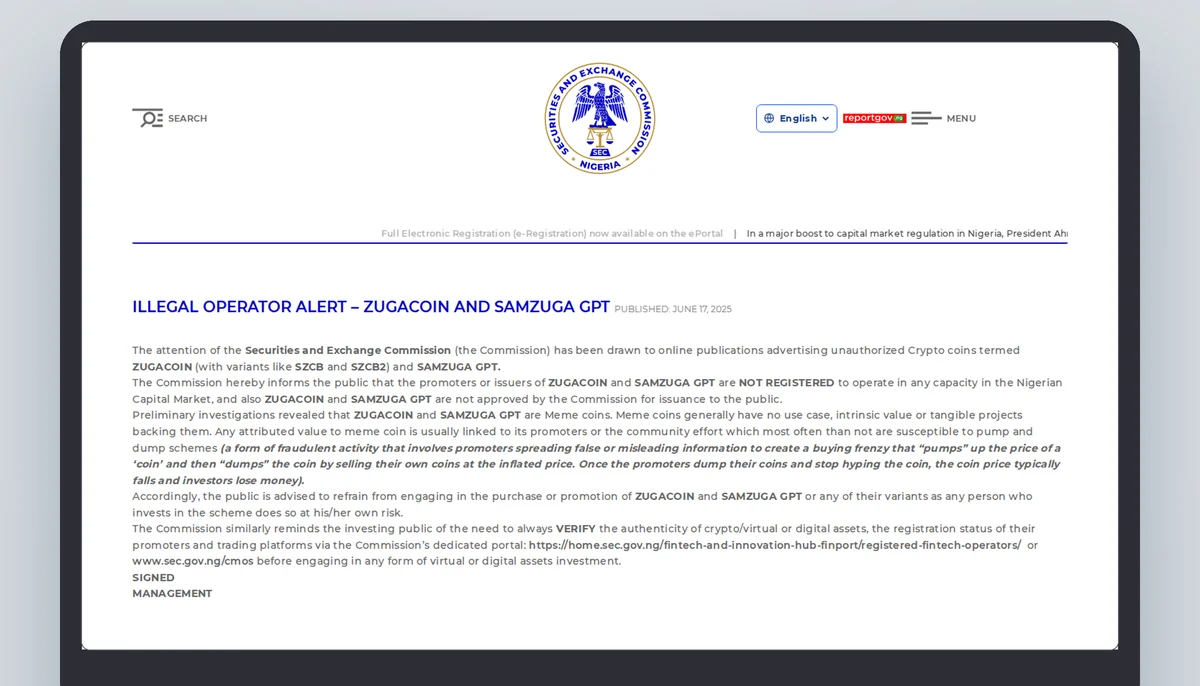
A platform can be warned by the Securities and Exchange Commission and still run a working trading bot. The warning does not prove that the bot is fake, and the bot's existence does not erase the warning. The two facts sit side by side, and the reader has to weigh them. The warning is a dated act by a public body; the bot's performance is an unverified claim.
The SEC warning usually addresses one thing: the platform is not registered to offer investments in Nigeria, or it is using a name that is not on any licence. That is a legal status, not a judgment about the software. A platform can be unregistered and still have a bot that trades. The question for the reader is not whether the bot works, but whether they are willing to send money to an unregistered entity.
The date of the warning matters because platforms rebrand. A warning from years ago may refer to a name that has since changed, and the new name may not be in the SEC's list. That is why the site shows the dates. A warning is not a verdict; it is a timestamp. The reader who sees a warning and a promise together has to decide which one is more relevant to the transfer they are about to make.
Key facts
Read next
The last questions before paying
What is an AI trading bot?
It is a computer program that claims to trade automatically using artificial intelligence. The claim is that it can make profits without human intervention. The claim is unverifiable from outside.
Can I verify that the bot exists?
No. There is no public record of the bot's code or trading history. The bot could be a simulation. A real product would disclose the legal entity, the venue, and the custody of money.
Is the balance shown real?
You cannot verify it. The balance could be a number in a database. A real balance is held by a custodian and shown in a statement from that custodian. Ask for the custodian's name.
Will withdrawals work?
You cannot know until you try. The first small withdrawal may be paid to build trust. Larger withdrawals may be delayed or denied. Written withdrawal terms are a minimum requirement.
What should I ask before depositing?
Ask for the legal entity, the regulator, the venue where orders are placed, and the custodian of funds. Ask for written withdrawal terms. If those are not provided, do not deposit.
Open a CFD account with FxPro
If you want to trade CFDs after doing your own checks, FxPro offers currencies, metals, indices, shares and crypto on several platforms. This site is not the broker and takes no money from you.