
SEC Nigeria warnings, ordered by the date it gave
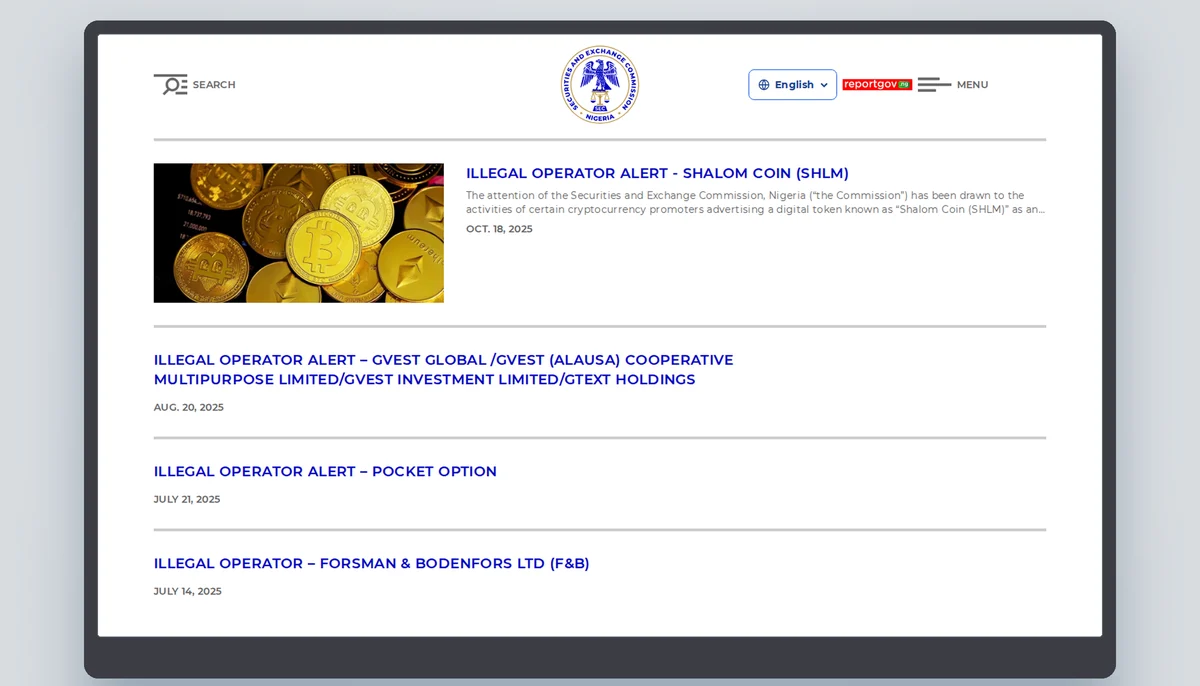
The Securities and Exchange Commission of Nigeria publishes warnings about platforms that promise to double money or trade for you with AI. This page shows those warnings in a live table above this text, ordered by the date the SEC gave. The date is the most useful column because it tells whether a warning describes the present or the past. A row records what the source published, not a finding of ours.
Warnings, newest first
Each warning's date as the SEC gave it, with undated rows last.
| Name as the SEC wrote it | Published | Kind of notice | Source |
|---|---|---|---|
| October 2025 | |||
| Shalom Coin (SHLM) | 18.10.2025 | Illegal operator alert | SEC ↗ |
| August 2025 | |||
| GVEST GLOBAL | 20.08.2025 | Illegal operator alert | SEC ↗ |
| July 2025 | |||
| Forsman & Bodenfors LTD (F&B) | 14.07.2025 | Illegal operator alert | SEC ↗ |
| Pocket Option | 21.07.2025 | Illegal operator alert | SEC ↗ |
| June 2025 | |||
| CBEX (Crypto Bridge Exchange) | 11.06.2025 | Illegal operator alert | SEC ↗ |
| CMTrading | 20.06.2025 | Illegal operator alert | SEC ↗ |
| Punisher Coin | 05.06.2025 | Illegal operator alert | SEC ↗ |
| Sapphire Scents Limited | 19.06.2025 | Illegal operator alert | SEC ↗ |
| Value Growth Platform | 30.06.2025 | Illegal operator alert | SEC ↗ |
| ZugaCoin and Samzuga GPT | 17.06.2025 | Illegal operator alert | SEC ↗ |
| May 2025 | |||
| Property World Africa Network (PWAN) | 06.05.2025 | Notice | SEC ↗ |
| Silverkuun Investment Cooperative Society | 28.05.2025 | Illegal operator alert | SEC ↗ |
| April 2025 | |||
| CBEX(Crypto Bridge Exchange) | 17.04.2025 | Notice | SEC ↗ |
| Tofro.com | 30.04.2025 | Notice | SEC ↗ |
| March 2025 | |||
| Mainland Trust Limited | 14.03.2025 | Notice | SEC ↗ |
| My Shares And UYJ Multitrade Limited | 06.03.2025 | Illegal operator alert | SEC ↗ |
| Provest | 06.03.2025 | Illegal operator alert | SEC ↗ |
| November 2024 | |||
| Marino FX Ltd | 25.11.2024 | Illegal operator alert | SEC ↗ |
| July 2024 | |||
| Scammer Alert | 05.07.2024 | Notice | SEC ↗ |
| June 2024 | |||
| Alpha Trust Investment Club (ATIC) | 26.06.2024 | Notice | SEC ↗ |
| Ponzi: Famzhi Boss Jailed Five Years for Investment Scam | 19.06.2024 | Notice | SEC ↗ |
| April 2023 | |||
| Blacklisting Of Six (6) Unregulated Online Trading Platforms | 27.04.2023 | Notice | SEC ↗ |
| March 2023 | |||
| Blacklisting Of Five (5) Italian E-Commerce Websites | 30.03.2023 | Notice | SEC ↗ |
| February 2023 | |||
| Ponzi: Court Sets March 16 for Trial of Vektr Capital & 2 Ot | 13.02.2023 | Notice | SEC ↗ |
| December 2022 | |||
| Blacklisting Of Four (4) Italian E-Commerce Companies | 22.12.2022 | Notice | SEC ↗ |
| March 2022 | |||
| Some Unregistered Investments Schemes | 17.03.2022 | Notice | SEC ↗ |
| December 2021 | |||
| FinAfrica Investment Limited (Chinmark Group) | 25.12.2021 | Notice | SEC ↗ |
| Poyoyo Investment (Pilvest) Nigeria Limited | 24.12.2021 | Notice | SEC ↗ |
What each column shows
The table above has four columns. The first is the name exactly as the source wrote it. The second is the date the source published it. The third says whether the SEC gave a date; if not, the row is marked as undated. The fourth is a link to the original. The link goes to the SEC's own page, not to a copy. A reader should open the original to see the full text, because the table is a summary.
The name column is not edited or corrected. If the SEC wrote a name with a typo, the table shows the typo. That matters because a reader searching for a platform may miss it if the spelling differs. The date column is the one to read first. A warning from years ago describes a platform as it was then. A warning from last week is more likely to describe the present. The undated rows are listed last, because without a date their age is unknown.
Why the date is the most useful column
A warning is a public statement made at a point in time. The date tells you when the regulator spoke. A platform may have been warned about long ago and rebranded since. The date lets you see that. If the warning is old, the platform may have changed its name, its operators, or its methods. The warning does not automatically follow the new name. A reader comparing an old warning with a new platform must compare the underlying details.
The date also shows whether the SEC has warned about a platform recently. If a platform is being promoted now and the SEC warned about it last week, that is a strong signal. If the warning is from years ago, the signal is weaker. The date is not a verdict. It is a piece of evidence about when the regulator looked at the platform. The reader decides what to do with it.
Rows without a date exist
The SEC sometimes publishes a list of known schemes without a date for each entry. Those rows are listed last and marked as undated. An undated warning is still a warning, but its age is unknown. That matters because a platform may have changed since the regulator last looked at it. The absence of a date is not absence of a warning. A reader who finds a name on the list should open the original notice linked in the row.
The original may have a date in its text even if the list does not. If the original has no date either, the reader should treat the warning as old. The table does not invent a date. It marks the row as undated. That is an honest description of what the source published. A reader should not assume an undated warning is current.
A row records what the source published, not a finding of ours
Each row in the table is a summary of one SEC publication. The name, the date, and the link are taken from the SEC's website. The table does not add commentary. It does not say whether the platform is a scam or a fraud. It does not link one name to another. A reader who wants to know more should open the original. The original is the regulator's own words.
The table is a reference, not an accusation. A listing is a regulator's act, not our verdict. The site does not conclude that a platform is dangerous. It records that the SEC published a warning on a date. The reader decides what to do with that. The table is a tool for the minute before a transfer.
How to use the timeline
Start with the name you have. Search the table for it. If it is there, look at the date. If the date is recent, the warning is more likely to describe the present. If the date is old, the platform may have changed. Open the original to see what the SEC actually said. The original may name a bank account or a website. Compare those details with the platform you are looking at.
If the name is not in the table, that does not mean the platform is safe. The SEC's list is not a complete register of every platform operating in Nigeria. Absence of a warning is not a sign of registration or safety. A reader should still do the checks on the deposit checklist page. The timeline is one piece of evidence, not the whole picture.
What the timeline does not show
The timeline shows only what the SEC has published. It does not show warnings from other regulators, such as the Central Bank of Nigeria or the EFCC. It does not show court cases or news reports. It does not show whether a platform is registered with the SEC. The SEC has a separate register for registered operators; this timeline is about warnings, not registrations.
A reader who wants a complete picture should check multiple sources. The SEC's register for registered operators is one place. The CBN's warnings about banks are another. The EFCC's press releases are a third. This site links only to the SEC's warnings. It is a narrow reference for a specific question: has the SEC warned about this platform, and when?
A warning can become stale without being withdrawn
The table keeps the exact date the SEC published each warning, and that date matters for a practical reason. A platform named in an old row may have changed hands, changed its name, or moved its operations since that publication. The regulator does not always issue a follow-up when that happens.
When a warning is old, the risk is not that the SEC was wrong at the time. The risk is that the warning now describes a different business than the one a reader is looking at. The name may be the same while the people behind it are not.
Before acting on any row, check whether the platform still uses the same website, the same payment channels, and the same claims as the day the SEC published. If those have changed, the warning may not describe what is in front of you now.
The withdrawal route is the first thing a platform will obscure
Every deposit is a promise to return money later, and the route for that return is where most disputes begin. A platform that is clear about how money comes back will state the method, the timing, and the conditions in writing before a deposit.
When the route is vague, the usual pattern is that deposits are accepted through one channel while withdrawals are pushed to another. The customer is then told that a fee is needed, or a new minimum balance, or a verification step that was not mentioned at the start.
Ask for the withdrawal route in writing, and ask what happens if the route is unavailable. If the answer is that the route will be decided later, that is a signal the platform has not designed a way for money to leave.
A regulator's warning does not stop a platform from collecting deposits
The SEC can publish a warning, but publication alone does not block a website or freeze a bank account. Between the date of a warning and any enforcement action, a platform may continue to operate and to accept money.
That gap is why the table is useful in the minute before a transfer. A reader can see that a warning exists and make a decision immediately, without waiting for the regulator to act. The warning is a signal, not a shutdown.
If a platform is still taking deposits after a warning, that does not mean the warning was false or withdrawn. It means the enforcement process moves at a different pace than a payment.
A written record turns a promise into evidence
The page lists what to have in hand before a first deposit, and the written record is the item that makes every other item usable. A screenshot, a chat log, or an email that shows the promise is what a bank or a regulator can act on later.
Without a record, a dispute becomes one person's word against another's. The platform can say the promise was never made, or that the customer misunderstood. A written record removes that defence.
Keep the record outside the platform's own app. If the platform deletes the chat or closes the account, a screenshot stored only in that app is gone. Save it to a device or a service the platform does not control.
A warning dated long ago may describe a platform that has since changed its name
The SEC publishes a warning with the name a platform used at that moment. A platform that was warned about under one name may later operate under another name, with the same people behind it and the same kind of offer. The new name may not appear in the table because the regulator has not published a warning using that new name. The old warning remains on the table, but a reader searching for the new name will not find it.
The date column shows when the regulator published each warning. It does not show when a platform started or stopped using a name. A row that is a year old may describe a platform that has already rebranded. A row that is new may describe a platform that has been operating under that name for some time before the warning appeared. The date is the date of the regulator's act, not the date of the platform's birth.
Before a first deposit, a reader should compare the name the platform is using now with the names in the table. If the offer is the same but the name is different, the warning may still be relevant. The regulator's warning describes a mechanism, and a mechanism can survive a change of name. The reader should also ask for the exact legal name and registration details, then check whether those details connect to any row in the table.
A written record of every promise is the part most often missing when a dispute begins
The checklist includes a written record of every promise, but the practical consequence is larger than the checklist suggests. When a platform fails to pay, the conversation moves to a dispute, and the dispute turns on what was promised at the time of deposit. A promise made in a chat message or a phone call is hard to prove later. A written record kept by the depositor changes what can be shown to a bank, a payment provider, or the SEC.
The record should include the exact amount sent, the date and time, the wallet or account number used, and the words the platform used to describe the return and the withdrawal process. Screenshots are useful, but a screenshot can be edited, so a reader should also keep the original messages and any emails. If the platform sends a confirmation, that confirmation should be saved in the same place as the deposit receipt.
When a platform later changes its terms, the earlier written record becomes the baseline. A platform may say that the return was never guaranteed, or that the withdrawal depended on a trading result. The written record shows what was said at the moment of deposit, and that is the version a dispute will be judged against. The record is not a guarantee of safety, but it is the difference between an argument and evidence.
Key facts
Read next
The last questions before paying
What does the date column mean?
The date column is the date the SEC gave for the warning. It is the date of publication, not necessarily the date the platform started operating. If the SEC gave no date, the row is marked as undated and listed last. The date tells you whether the warning is recent or old.
Why are some rows undated?
The SEC sometimes publishes a list of known schemes without a date for each entry. Those rows are marked as undated. An undated warning is still a warning, but its age is unknown. The original notice may have a date in its text even if the list does not.
Does a warning mean the platform is a scam?
No. A warning is the regulator's public statement; it is not a court finding. The site records that the SEC published a warning on a date. It does not conclude that the platform is a scam or a fraud. The reader decides what to do with the information.
What if a platform is not in the table?
Absence of a warning is not a sign of registration or safety. The SEC's list is not a complete register of every platform operating in Nigeria. A reader should still do the checks on the deposit checklist page, such as verifying the legal name and the regulator.
Can I rely on this table alone?
No. The table is a summary of the SEC's warnings. It does not include warnings from other regulators or court cases. A reader should check multiple sources, including the SEC's register for registered operators and the CBN's warnings.
Open a CFD account with FxPro
If you want to trade CFDs after doing your own checks, FxPro offers currencies, metals, indices, shares and crypto on several platforms. This site is not the broker and takes no money from you.