
A plain guide to SEC warnings and pre-deposit checks.
The Securities and Exchange Commission of Nigeria publishes warnings about platforms that promise to double money or trade for you with AI. This page shows how to read those warnings by date and what to have in hand before a first deposit.
Three ways in
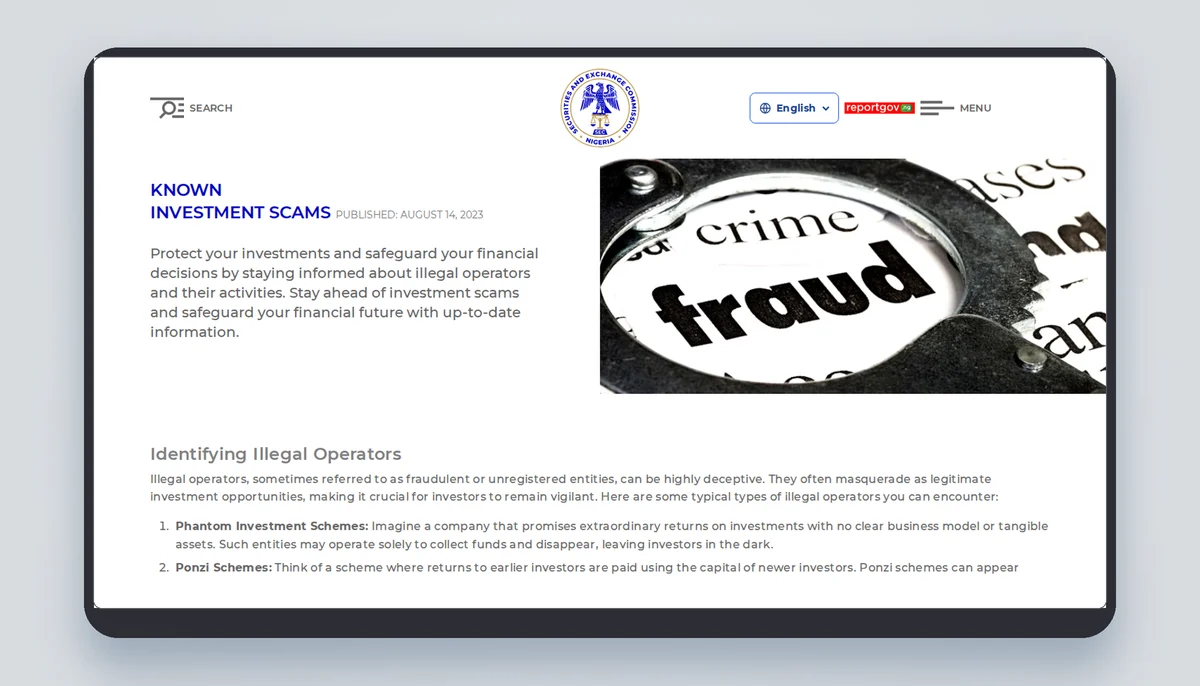
Warnings in order of the date the SEC published them
The order is the SEC's own publication dates, newest first. Each row is one notice under the name the SEC used; a rebrand can make an old warning look unrelated, so compare the details, not the name.
| Name as the SEC wrote it | Published | Kind of notice | Source |
|---|---|---|---|
| October 2025 | |||
| Shalom Coin (SHLM) | 18.10.2025 | Illegal operator alert | SEC ↗ |
| August 2025 | |||
| GVEST GLOBAL | 20.08.2025 | Illegal operator alert | SEC ↗ |
| July 2025 | |||
| Forsman & Bodenfors LTD (F&B) | 14.07.2025 | Illegal operator alert | SEC ↗ |
| Pocket Option | 21.07.2025 | Illegal operator alert | SEC ↗ |
| June 2025 | |||
| CBEX (Crypto Bridge Exchange) | 11.06.2025 | Illegal operator alert | SEC ↗ |
| CMTrading | 20.06.2025 | Illegal operator alert | SEC ↗ |
| Punisher Coin | 05.06.2025 | Illegal operator alert | SEC ↗ |
| Sapphire Scents Limited | 19.06.2025 | Illegal operator alert | SEC ↗ |
| Value Growth Platform | 30.06.2025 | Illegal operator alert | SEC ↗ |
| ZugaCoin and Samzuga GPT | 17.06.2025 | Illegal operator alert | SEC ↗ |
| May 2025 | |||
| Property World Africa Network (PWAN) | 06.05.2025 | Notice | SEC ↗ |
| Silverkuun Investment Cooperative Society | 28.05.2025 | Illegal operator alert | SEC ↗ |
| April 2025 | |||
| CBEX(Crypto Bridge Exchange) | 17.04.2025 | Notice | SEC ↗ |
| Tofro.com | 30.04.2025 | Notice | SEC ↗ |
| March 2025 | |||
| Mainland Trust Limited | 14.03.2025 | Notice | SEC ↗ |
| My Shares And UYJ Multitrade Limited | 06.03.2025 | Illegal operator alert | SEC ↗ |
| Provest | 06.03.2025 | Illegal operator alert | SEC ↗ |
| November 2024 | |||
| Marino FX Ltd | 25.11.2024 | Illegal operator alert | SEC ↗ |
| July 2024 | |||
| Scammer Alert | 05.07.2024 | Notice | SEC ↗ |
| June 2024 | |||
| Alpha Trust Investment Club (ATIC) | 26.06.2024 | Notice | SEC ↗ |
| Ponzi: Famzhi Boss Jailed Five Years for Investment Scam | 19.06.2024 | Notice | SEC ↗ |
| April 2023 | |||
| Blacklisting Of Six (6) Unregulated Online Trading Platforms | 27.04.2023 | Notice | SEC ↗ |
| March 2023 | |||
| Blacklisting Of Five (5) Italian E-Commerce Websites | 30.03.2023 | Notice | SEC ↗ |
| February 2023 | |||
| Ponzi: Court Sets March 16 for Trial of Vektr Capital & 2 Ot | 13.02.2023 | Notice | SEC ↗ |
| December 2022 | |||
| Blacklisting Of Four (4) Italian E-Commerce Companies | 22.12.2022 | Notice | SEC ↗ |
| March 2022 | |||
| Some Unregistered Investments Schemes | 17.03.2022 | Notice | SEC ↗ |
| December 2021 | |||
| FinAfrica Investment Limited (Chinmark Group) | 25.12.2021 | Notice | SEC ↗ |
| Poyoyo Investment (Pilvest) Nigeria Limited | 24.12.2021 | Notice | SEC ↗ |
Six pages for the minute before a transfer
- Dated warning timelineThe SEC's warnings in order of the date it gave, with a live table above the text.
- How doublers workThe 'double your money' mechanism explained in words, with no figures.
- AI bot promisesWhat an AI trading bot offer claims and what cannot be verified from outside.
- Deposit checklistThe questions to put before any deposit: legal name, regulator, withdrawal route.
- After a transferWhat to do in the first day after sending money on a doubtful promise.
- Testimonials and screenshotsWhy screenshots and endorsements are not evidence, and what checkable proof looks like.
A warning from a year ago is a different document from a warning published this week
The date on a warning fixes the platform's identity at that moment. A platform warned about in the past may have changed its trading name, its website address, or the person who answers chats. The same people can run a new front while the old warning stays online, still describing the old name.
A reader who finds a warning from long ago and then sees a different name today often assumes the regulator has cleared the new name. That assumption is not supported by the register. The register records what was published and when; it does not update a warning to track a rebrand.
The practical step is to read the warning and ask whether the platform you are looking at now matches the one described then. If the only difference is the name, the warning's age does not make it irrelevant. The date tells you how long the regulator's statement has been in public view, not that the risk has expired.
A platform's legal name is not the name on its adverts
Most adverts show a brand name, a slogan, or a shortened address. The legal name is what the company filed when it registered, and it may be completely different. A deposit made to a brand name with no legal entity behind it is a payment to whoever controls that brand.
The check before a first deposit is to ask for the exact legal name and the registration number. Then confirm that name against the regulator's public records. A platform that gives only a brand name or a trading style has not answered the question.
The reason this matters is that a dispute later will require a named defendant. If the only name you have is a brand, you cannot file a claim against a brand. The legal name is what turns a chat conversation into a record that a court or a regulator can act on.
A registration number is not a licence to take deposits
A company can be registered with the Corporate Affairs Commission and still have no permission to collect funds from the public for investment. Registration means the company exists as a legal person; it does not mean the company is authorised to trade for you or to hold your money.
The regulator named by the platform should be the Securities and Exchange Commission for investment services. A platform that names a different regulator, or no regulator, is not offering the same category of service. The reader should ask which specific law or rule permits the platform to take deposits.
A common confusion is between a business registration and a market operator's licence. The first is about existence; the second is about permission. Before a first deposit, the reader should see the licence, not just the registration certificate.
The withdrawal route is the part of the offer most often left vague
A platform that cannot explain how money comes back is a platform that expects you to focus only on the money going in. The withdrawal route includes the method, the time it takes, any conditions, and who approves the request. Most adverts describe deposits in detail and withdrawals in a single line.
The check is to ask for a written statement of the withdrawal process before the deposit. The statement should name the bank or payment channel, the maximum amount per withdrawal, and the steps from request to credit. A refusal to provide this in writing is itself a finding.
The reason to do this before a deposit is that afterwards your leverage is gone. Once the money is in the platform's account, the terms of return are whatever the platform says they are. A written withdrawal route is the only thing that can hold a platform to a promise.
A screenshot of a payment is a picture, not a withdrawal
Screenshots are shared in chats and groups to show that someone received money. A screenshot proves that an image was created; it does not prove that a bank transfer occurred, that the sender was a real client, or that the recipient was the person showing the screenshot.
The mechanism is simple: a payment notification can be edited, generated, or borrowed from another transaction. The date and amount on the image can be changed with common tools. A platform that relies on screenshots to prove payouts is relying on the cheapest form of evidence.
The reader should ask for a verifiable receipt from the payment provider, such as a bank reference or a transaction ID that can be checked independently. A screenshot is not a receipt. In a dispute, a screenshot may be worth less than the paper it is not printed on.
A written record of every promise is the only thing that survives a dispute
Promises made in a chat or a phone call disappear. A written record is a copy of the conversation, the advert, the terms, and the withdrawal statement, kept outside the platform's control. Without it, a dispute becomes your word against theirs.
The record should include the date and time of each message, the name of the person who made the promise, and the exact words used. Screenshots of the platform's own interface are useful, but they can be changed after the fact. A copy kept in your own email or cloud storage is harder to alter.
The reason this comes last is that it is the least exciting check and the one most often skipped. A reader will spend an hour reading reviews and five minutes saving promises. The five minutes are the part that a lawyer or a regulator will ask for first.
A warning's date counts more when the platform still takes deposits
The date on a regulator's warning tells you when the problem became public knowledge, not when it ended. A platform that was warned about months ago and still takes deposits has had time to change its bank details, its social media handles, and the name on its website. The warning remains on the SEC's site, but the platform it describes may already be running under a different name with the same promise. That is why the date column is the first thing to check, not the last.
A warning published a long time ago may be the only public trace of a platform that has since split into several smaller ones. Each new version starts with a clean name and no warning against it, yet the mechanism underneath is unchanged. The people behind it count on you seeing the old warning as irrelevant. They want you to think the new name is a new company. It is not.
When a platform shows you a registration number, check the date on that registration against the date of any warning. A company registered after a warning was issued is not the same as a company cleared by the regulator. The registration may be real and still mean nothing about the promise it now makes. The SEC's warning stands until the platform itself shows a written reversal from the regulator, not a testimonial from a person who was paid to leave it.
A withdrawal route that changes after deposit is the signal to stop adding money
Every platform describes a withdrawal route at the point of deposit: a bank transfer, a crypto address, a card credit. The moment that route changes after your money is in, the platform has altered the one term that matters most. A new fee, a new minimum, a new waiting period, or a request to send more money to 'verify' your account are all forms of the same change. None of them bring your original deposit closer to your own bank account.
A written record of the original withdrawal terms is the only thing that can be compared against a later change. If the platform gave you nothing in writing, then the change is not a breach of any promise you can prove. That is why the checklist on this site asks for a written statement of how withdrawals work before the first deposit. A chat message is better than a voice call, and a document is better than a chat message.
When a withdrawal route changes, the platform will explain it as a security measure, a banking delay, or a market condition. Those explanations are not evidence. The only evidence is whether the amount you requested arrives in the account you control, within the time and at the cost that was written down first. If it does not, the next deposit is not a step toward recovery; it is a second loss.
Open a CFD account with FxPro
If you want to trade CFDs after doing your own checks, FxPro offers currencies, metals, indices, shares and crypto on several platforms. This site is not the broker and takes no money from you.